

AFTER YEARS OF SEVERE BACK PAIN, SPECIALIST VISITS, AND VARIOUS TREATMENTS, A HOLYOKE MAN FINALLY FINDS RELIEF.
 JIM HOEY, a retired civil engineer and avid golfer who lives in Holyoke, had experienced back problems most of his adult life. “I could count on my back going out once a year on average,” he says. “A week on the sofa would usually do the trick.”
However, when his back went out in 1996 and a week on the sofa didn’t help, Jim underwent surgery to remove a portion of the disk between L4 and L5, the two lowest vertebrae of the lumbar spine.
Then in 2017, Jim started to have back pain again, and the old standby—a week on the sofa—did nothing to relieve it. His doctor ordered an MRI, and Jim was told that he wasn’t a candidate for surgery. Instead, he was prescribed medications to help manage his pain.
MORE PAIN, NO RELIEF
In June 2024, after seven years of being relatively symptom-free, Jim began experiencing pain once again. This time, it increased to the point that it prevented him from doing many activities. Before his pain became debilitating, Jim had spent most of his time working around the yard, building a barn, golfing from March through December, and occasionally skiing. Now, those activities seemed to be squarely in the past. “For my sanity, I would still attempt golf on the ‘good’ days, but those were very rare,” he says. “It was hard not being able to pick up my grandkids.”
In July 2024, Jim saw a chiropractor and then an acupuncturist, but neither helped. His back pain soon intensified and began radiating down to his left thigh and scrotum. He saw an orthopedic surgeon, had another MRI, and was again told he didn’t need surgery.
Instead, he was referred to a sports medicine specialist and to a urologist for the radiating testicular pain. The urologist confirmed what Jim already knew—that the testicular pain was related to his back issues—and the sports medicine specialist gave him two steroid injections, which helped for no more than a day or two.
“By this time, I was walking around with an ice pack strapped to my back 24/7,” Jim says. “I couldn’t do yard work, I couldn’t play golf, and I had to sleep half sitting up because if I was lying down, I would often wake up with additional pain down my left leg.”
At one point, his wife took him to the Holyoke Medical Center (HMC) emergency department.
A LIFE-CHANGING MOMENT
In November 2024, Jim’s sister and his mother-in-law each separately gave him a copy of the Fall 2024 issue of Valley Health & Life. “It contained an article on a woman named Pam Miner [“Second Time’s the Charm”] and her successful spine surgery performed by Dr. Pennings,” Jim recalls. “Within a week of reading the article, I called to schedule an appointment with him.”
On Dec. 6, 2024, after having sent a copy of his MRI report to the office, Jim met Frederik Pennings, MD, PhD, who heads the Institute for Minimally Invasive Spine Surgery at HMC and is the only fellowship-trained neurosurgeon in the area. Having already reviewed Jim’s MRI report, Dr. Pennings asked Jim for a brief history of his back issues. After examining him, Dr. Pennings sent Jim upstairs for X-rays. When Jim returned to Dr. Pennings’ office, he told Jim he was confident he had a solution that would alleviate his pain.
“Jim’s X-ray showed scoliosis in the lumbar spine and foraminal stenosis, a narrowing of the openings [foramina] where the nerves come out of the spine, causing nerve compression,” Dr. Pennings says.
A procedure to widen the foramina is often used to treat the nerve compression caused by foraminal stenosis. However, Dr. Pennings felt that in Jim’s case, it would provide only temporary relief. “His symptoms would have come back, because that surgery would not have corrected the cause of his foraminal stenosis, which was degenerative scoliosis.”
THE RIGHT SURGERY
Dr. Pennings suggested an oblique lumbar interbody fusion (OLIF), a minimally invasive surgery that could correct the scoliosis and straighten his spine. “He explained the procedure and showed me the hardware involved,” Jim says. “He also assured me that I would be able to golf again, but to plan on waiting six months after surgery.”
On Jan. 29, 2025, Dr. Pennings performed Jim’s OLIF through a small incision in the side of his body between his rib cage and hip bone. The entire procedure took about two and a half hours, and Jim was discharged the next day.
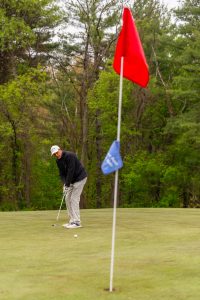 “We saw him three weeks later, and the pain through his thigh and scrotum had resolved,” Dr. Pennings says. “By April 2025, he had almost complete pain relief, and when we last saw him in February 2026, he was doing remarkably well. He told me he had golfed more than 100 times in the past year with virtually no pain.”
Jim confirms: “Actually, I finished 2025 with just over 150 rounds at Southampton Country Club, and I continue to golf every weekday with my brother Mark.”
In addition to golfing again, he also traveled out West with his wife this past winter to ski Breckenridge, Vail, and Keystone.
TRUST AND RELIEF
Jim is grateful to his sister and his mother-in-law, who led him down his path to recovery. “It was reading about Pam Miner’s experience in Valley Health & Life that connected me to Dr. Pennings and gave me back my normal life,” Jim says.
He’s also thankful to the doctor and his staff. “When I first met Dr. Pennings, I immediately felt very comfortable,” Jim says. “When he took me into his office to explain the issue and provide a solution, I had a feeling of trust and overwhelming relief. I felt that he was truly concerned with my well-being, which was further confirmed during his visits to check on my recovery.”
Jim also notes that the entire staff was very professional and congenial, and the nurses treated him “like family” during his overnight stay. He says he could not have asked for a better experience.
The Institute for Minimally Invasive Spine Surgery at Holyoke Medical Center is located at 10 Hospital Drive, Suite 101, in Holyoke and is accepting new patients. To learn more, please call 413.535.4860.