

Pay Your Bill

Patient Portal

Mobile Pre-Check

Make an Appointment

Pam Miner

Successful Spine Surgery Patient

SECOND TIME’S THE CHARM

AN INSURANCE DENIAL AND A MISDIAGNOSIS LED THIS PATIENT TO HMC’S INSTITUTE FOR MINIMALLY INVASIVE SPINE SURGERY—AND RELIEF FROM DEBILITATING PAIN.

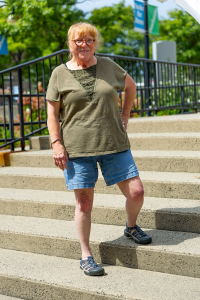
Pam standing on stepsPAM MINER, a retired convenience store owner who lives in Colrain with her husband, Joe, had been living with severe lower back pain for more than two years, and it was getting worse. By the time she saw her primary care doctor in the spring of 2023, she was walking with a cane and was unable to stand for more than a couple minutes without excruciating pain.

Pam had had a hip replacement 21 years earlier, and originally thought there might be a problem with the replaced hip. So she made an appointment with a doctor who performed hip replacement revisions. “He told me I had no problems in my hips, and that my replacement was stellar,” she says. With her hips ruled out as a source of pain, in September 2023, Pam’s primary doctor referred her to a physical medicine and rehabilitation physician who diagnosed her with sacroiliitis, a condition that affects the sacroiliac (SI) joints, causing pain and stiffness in the lower back and/or buttocks. “He did no diagnostic tests, no X-rays, no MRI—nothing,” says Pam. “He was just guessing.”

Pam was given cortisone injections in the sacroiliac joints, but the resulting pain relief was short-lived. So the doctor recommended radiofrequency ablation (RFA) of the sacroiliac joints, which uses radiofrequency waves to produce heat that damages the nerves so that they can no longer transmit pain signals from the sacroiliac joints to the brain. “What put the kibosh on that is that my insurance wouldn’t cover it,” says Pam. “I was so upset then but, boy, it saved my life!”

ENTER THE INSTITUTE FOR MINIMALLY INVASIVE SPINE SURGERY AT HMC

With no other treatment option to offer based on his diagnosis, the doctor referred Pam to Frederik Pennings, MD, who leads the then newly opened Institute for Minimally Invasive Spine Surgery at Holyoke Medical Center (HMC). But first, he ordered an MRI, which was required for Pam to see Dr. Pennings.

“When I met Dr. Pennings in January 2024, he said, ‘Tell me your story,’” recalls Pam. “I told him mornings are really bad; I don’t sleep well.” Dr. Pennings, an internationally recognized expert in minimally invasive spine surgery and the only spine fellowship-trained neurosurgeon in the area, asked Pam whether she slept on her back or on her side. She told him she went from side to side and that she couldn’t sleep on her back. “He said, ‘People with SI joint problems can’t sleep on their side,’” says Pam. “How come all spine doctors don’t know that?”

During that first appointment, Dr. Pennings sent Pam to have X-rays taken of her spine. “Then I went back to his office and we finished my appointment,” she says. “I was so impressed with that.”

THE CORRECT DIAGNOSIS

According to Dr. Pennings, Pam’s symptoms were not compatible at all with sacroiliitis. “Her symptoms— pain in the back when walking or standing that gets better when sitting, leaning forward or using a cane— were indicative of spinal stenosis (a narrowing of one or more spaces within the spinal canal),” he says. “I made the diagnosis based on her history, her symptoms and the MRI and X-rays.”

Pam’s MRI was very significant, according to Dr. Pennings. “It showed a lot,” he says. “In addition to spinal stenosis, she also had degenerative lumbar scoliosis, a curve of the spine, as well as spondylolisthesis, a condition where one vertebral body slips forward onto the one below it. That combination lumbar scoliosis and spondylolisthesis caused the spinal stenosis.”

The X-ray also contained valuable information. “When you have an MRI, you’re lying down, so the gravity is not there. Because of that, you won’t see the scoliosis that much,” says Dr. Pennings. “But if somebody is standing, the gravity works, and you see the scoliotic curve and the spondylolisthesis much better. That’s why, in spine cases, it’s important not just to do an MRI, but to do a regular X-ray, which is often overlooked by doctors.”

Pam discussed her options with Dr. Pennings and it was determined that she needed surgery to correct her conditions. “It was crystal clear what needed to be done,” says Pam. “I was done messing around.”

INDIRECT DECOMPRESSION

On April 29, 2024, Dr. Pennings performed an oblique lumbar interbody fusion (OLIF) on Pam. “This is a minimally invasive technique that approaches the spine from the side through a one-inch incision in the left lower abdominal quadrant,” says Dr. Pennings. “Through that incision, I put spacers in from one side of the disk to the other. This procedure not only corrects the scoliosis curvature but also reduces the slip (spondylolisthesis) and realigns the lumbar spine. Returning the lumbar spine to a relatively normal position creates the space needed for the nerves.”

According to Dr. Pennings, most surgeons in Pam’s case would have used an open direct decompression technique, which involves removing bone and ligaments and is a much bigger undertaking. Dr. Pennings used a minimally invasive indirect decompression of the nervous structure. “With indirect decompression, I do not remove any bone, ligaments, or muscles,” he says. “Just by realigning the spine and putting it in the position it should be, I get the decompression the nerves need.” The procedure takes 90 minutes to three hours depending on the number of levels fused and involves minimally invasive placement of screws and two rods as well.

PAIN-FREE AT LAST

“I stayed overnight for observation and the next day, I could walk up the stairs,” says Pam. “My recovery was amazing. I felt much steadier right away and was walking with no pain. I’m still ecstatic over this. I can’t say enough about Dr. Pennings—I love that guy! He has a great personality, a great bedside manner, and he’s brilliant. I’m so grateful to him and to HMC.”

To learn more about the Institute for Minimally Invasive Spine Surgery at Holyoke Medical Center, please call 413.535.4860.